
Exciting News from the California Hands & Voices Chapter!

by California Hands & Voices

California Hands & Voices proudly hosted an ASTra level 1 training on February 2nd 2019 in San Diego, California. There were a total of 95 parent and professionals in attendance from all regions of California. We also want to recognize and thank the Hands & Voices Military Project for attending from your home states. Stay tuned for future training opportunities in California.

Each attendee walked away empowered with a better understanding of the basic components of educational advocacy for children who are Deaf or Hard of Hearing and are now equipped to advocate for their child or the children they support.
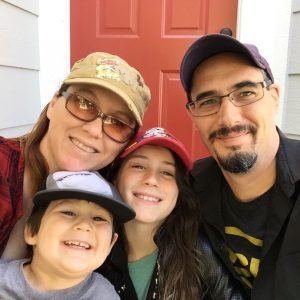
Case Family

Our Journey with Progressive Hearing Loss: In-between Two Worlds

by Amanda Case

It is hard to believe that it has been 6 1/2 years since we first received our daughter’s diagnosis of hearing loss. I still remember the fear that washed over me, suddenly feeling unequipped to be her mom. I had never known a Deaf person, I didn’t know ASL, what do we do next?

At age three, we had her fitted for her first hearing aid, enrolled her in the Special Education Preschool in our district, and met with an ENT and geneticist to see if we could see what was causing her hearing loss. Just as we were settling in to our “new normal,” we found out our daughter has Pendred Syndrome, which is characterized by progressive hearing loss and possible Goiter that presents in early adulthood.

Why Do I Think It Is So Important to Encourage Parent Support?

by Nancy Grosz Sager

California Department of Education (retired Spring 2018)

This is actually a no-brainer to me. We all know that the # 1 predictor of whether or not ANY child does well academically, socially, and vocationally is PARENT INVOLVEMENT. For a child who is Deaf or Hard of Hearing, strong parent involvement is even more important. And yet, young parents who have just learned that their beautiful little baby is Deaf or Hard of Hearing are uncertain about what to do, how to do it, and what is in store for them.

What I Wish I Knew When I was Sixteen Going through the College Search Process

by Brittany Comegna

Admissions Counselor at the National Technical Institute for the Deaf at the Rochester Institute of Technology

I did everything that I now tell students to NOT do.

I was a senior in high school at California School for the Deaf in Fremont. I was encouraged by teachers and school staff to attend a certain university after having submitted my application. I concurrently applied to California State University at Northridge (CSUN) where my older Deaf brother was attending. I had my heart set on a career in the film industry and believed CSUN could offer a lot in this area. I graduated from CSUN in December of 2010.

The Road We Travel TOGETHER: Our Family Journey

By Rosabel O. Agbayani, MPH

“If you want to change the world, go home and love your family.” -Mother Theresa

Sometimes we think that in order to make change we have to make a lot of noise. What I have learned from my experience of raising my children, and especially raising my deaf child, is that you have to be able to drown out the noise and listen to your heart.

We found out my son was deaf in September 2010. I’m not sure why I was so shocked because after almost 6 months of testing we finally had an answer. But I still remember that feeling when I heard the words “Your son has a hearing loss.”

The Funny Things on my Ears

by Michelle Hu Lapid

Pediatric Audiologist & Bilateral Cochlear Implant Recipient

If you told my mother 30 years ago that her daughter would graduate high school and college with honors, she actually might have had some doubts. This is because, thirty years ago, when the doctors confirmed my hearing loss, they also told her that I would likely not go beyond a 3rd grade reading level.

Staying Organized from the Start!

by Cora Shahid

California Hands & Voices Membership Chair

All parents intuitively want to be good advocates for their child but in the beginning, we might not know exactly how to do that. Here are some steps that you can take to help you be effective while becoming more experienced. Know your child’s strengths and weaknesses, the law and how it relates to your child, be courteous and respectful while standing up for your child’s rights, stay organized, keep track of conversations and be prepared for meetings.

Sensory Integration

by Gwen Suennen, M.A.

Have you ever wondered what enables our deaf or hard of hearing (DHH) child to attend/focus and perform in a certain way? One process which helps them is called “sensory integration”, which is the neurologic ability of our brain to organize information we receive through our senses and make appropriate motor and behavioral responses. It is essential for developing attention, body awareness, balance, fine and gross motor coordination, social/emotional growth, as well as academic skills. Without good sensory integration, learning is difficult and the child often feels uncomfortable about him/her self. This can lead to difficulty coping with ordinary demands and stress.

Putting the “Care” Back in Healthcare

by Rosabel Agbayani

Member of California Hands & Voices

I have always been attracted to the caring, compassionate, and purposeful work of health services. I spent 5 years working as an Administrative Medical Assistant in and worked in Healthcare Administration for several years with a focus on Patient Relations and Quality Improvement. Working with physicians and specialists providing health and human services, I thought I knew all there was to know about caring for people and helping families.

However, on September 30, 2010 my family received a diagnosis that would change the course of our lives. Our healthy and active 3½ year-old son Michael was diagnosed with Pre-lingual Moderate-Severe Bilateral Conductive Hearing Loss.

My Many Shoes

by Dakota Ronco

If you asked me whether being mainstreamed with interpreters or attending to a residential school for the deaf was better, I would not have an answer. My experiences shaped me into who I am. If I had graduated from a public high school, I would have not grown as much socially, nor would I have had opportunities to be thoroughly involved with my school. On the other hand, if I had grown up in a residential school for the deaf, I would not have learned how to adapt to various situations, how to stand up for myself, and how to ensure that I got what I needed to be successful.