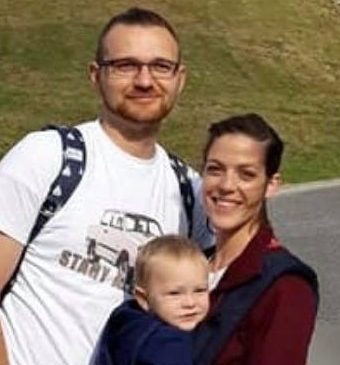
Hi we’re the B.’s! Jump to Polish version Our son was identified as being Single Side Deaf (he has a profound sensorineural loss on one side, normal hearing on the other) at six weeks old via ABR, after failing his…

Non-judgmental PARENT TO PARENT support that honorS each family’s unique journey
This is actually a no-brainer to me. We all know that the # 1 predictor of whether or not ANY child does well academically, socially, and vocationally is PARENT INVOLVEMENT. For a child who is Deaf or Hard of Hearing, strong parent involvement is even more important. And yet, young parents who have just learned that their beautiful little baby is Deaf or Hard of Hearing are uncertain about what to do, how to do it, and what is in store for them.
I did everything that I now tell students to NOT do.
I was a senior in high school at California School for the Deaf in Fremont. I was encouraged by teachers and school staff to attend a certain university after having submitted my application. I concurrently applied to California State University at Northridge (CSUN) where my older Deaf brother was attending. I had my heart set on a career in the film industry and believed CSUN could offer a lot in this area. I graduated from CSUN in December of 2010.
“If you want to change the world, go home and love your family.” -Mother Theresa
Sometimes we think that in order to make change we have to make a lot of noise. What I have learned from my experience of raising my children, and especially raising my deaf child, is that you have to be able to drown out the noise and listen to your heart.
We found out my son was deaf in September 2010. I’m not sure why I was so shocked because after almost 6 months of testing we finally had an answer. But I still remember that feeling when I heard the words “Your son has a hearing loss.”
If you told my mother 30 years ago that her daughter would graduate high school and college with honors, she actually might have had some doubts. This is because, thirty years ago, when the doctors confirmed my hearing loss, they also told her that I would likely not go beyond a 3rd grade reading level.
All parents intuitively want to be good advocates for their child but in the beginning, we might not know exactly how to do that. Here are some steps that you can take to help you be effective while becoming more experienced. Know your child’s strengths and weaknesses, the law and how it relates to your child, be courteous and respectful while standing up for your child’s rights, stay organized, keep track of conversations and be prepared for meetings.
Have you ever wondered what enables our deaf or hard of hearing (DHH) child to attend/focus and perform in a certain way? One process which helps them is called “sensory integration”, which is the neurologic ability of our brain to organize information we receive through our senses and make appropriate motor and behavioral responses. It is essential for developing attention, body awareness, balance, fine and gross motor coordination, social/emotional growth, as well as academic skills. Without good sensory integration, learning is difficult and the child often feels uncomfortable about him/her self. This can lead to difficulty coping with ordinary demands and stress.
I have always been attracted to the caring, compassionate, and purposeful work of health services. I spent 5 years working as an Administrative Medical Assistant in and worked in Healthcare Administration for several years with a focus on Patient Relations and Quality Improvement. Working with physicians and specialists providing health and human services, I thought I knew all there was to know about caring for people and helping families.
However, on September 30, 2010 my family received a diagnosis that would change the course of our lives. Our healthy and active 3½ year-old son Michael was diagnosed with Pre-lingual Moderate-Severe Bilateral Conductive Hearing Loss.
If you asked me whether being mainstreamed with interpreters or attending to a residential school for the deaf was better, I would not have an answer. My experiences shaped me into who I am. If I had graduated from a public high school, I would have not grown as much socially, nor would I have had opportunities to be thoroughly involved with my school. On the other hand, if I had grown up in a residential school for the deaf, I would not have learned how to adapt to various situations, how to stand up for myself, and how to ensure that I got what I needed to be successful.
Having confines set on you by other people is incredibly frustrating, especially when you and those close to you understand that you are completely capable of anything but hearing like everyone else. Anyone who has grown up deaf or hard-of-hearing understands exactly what I mean. It is also frustrating when, after years of learning to accept that it is okay to ask for help and accommodations, you are rejected.